
Call a local repair provider for a ballpark price before you drive anywhere. If a cracked screen, dead battery, or water damage has you searching for electronics repair near me, the fastest reliable path is a quick phone call to confirm the diagnostic fee, warranty terms, and turnaround time. When convenience and data safety matter most, an on-site same-day technician like Repair Genius skips the drop-off entirely. Either way, book or call today rather than waiting.
TL;DR:
- Calling a local repair provider upfront helps confirm costs, turnaround time, and warranty details, preventing unnecessary trips or surprises.
- For complex issues like motherboard damage or water corrosion, specialist or mail-in services are usually required, but they take longer and may involve shipping.
- On-site repair options offer same-day service and direct communication, making them ideal for quick fixes like screens or batteries, with transparent pricing and warranties.
- Asking specific questions about diagnostic fees, data handling, and warranty terms before booking reduces the risk of hidden costs or inadequate coverage.
- Repairs involving board-level work are best handled by specialists or mail-in centers, especially when diagnostics reveal internal component failures rather than simple parts.
Table of Contents
- Where to Find Electronics Repair Near Me: Shops, Specialists, and On-Site Techs
- What Does Electronics Repair Cost, and How Long Does It Take?
- What Should You Ask Before Booking a Repair?
- When Does a Repair Need a Specialist or Mail-In Service?
- Why On-Site Same-Day Repair Changes the Calculation
- Book On-Site Same-Day Repair With Repair Genius
- Sources
- FAQ
Where to Find Electronics Repair Near Me: Shops, Specialists, and On-Site Techs
Not every repair provider handles every problem, and figuring out which one fits your device saves you a wasted trip. The market for local electronics repair splits into four rough categories, and each has a sweet spot.
Walk-in phone and laptop shops handle the bulk of everyday jobs: cracked screens, battery swaps, charging ports, and basic software cleanups. They’re fast for common repairs but often subcontract anything unusual, like liquid damage that’s reached the motherboard.
Specialty electronics centers focus on a narrower set of devices or problems, such as gaming consoles, drones, or data recovery. They tend to carry deeper technical knowledge in their niche, which matters if your issue is outside the typical screen-and-battery routine.
Mail-in specialists accept shipments from anywhere and often handle board-level microsoldering that a local shop can’t. Mail-in repair centers commonly describe tracked intake and posted warranty terms, which give you a paper trail if something goes wrong during shipping or repair.
On-site mobile technicians come to your home, office, or a coffee shop and do the repair while you wait. This model trades a bit of shop-grade equipment for convenience and control. Your device never leaves your sight, which matters if you’re worried about data privacy.
Here’s how common problems typically map to the right provider:
- Cracked screen or shattered back glass: walk-in shop or on-site technician, usually same-day
- Battery that won’t hold a charge: walk-in shop or on-site technician, typically a relatively quick job
- Charging port full of lint or corrosion: walk-in shop or on-site technician
- Liquid exposure with no obvious damage: any provider for initial diagnostics, escalate if internal corrosion is found
- Laptop that won’t power on at all: specialty center or mail-in service, since this often points to a motherboard issue
- Data recovery after a crash: specialty center or mail-in service with dedicated recovery tools
- Business network or multi-device IT issues: on-site technician or business IT support
Cost and capability trade off directly against speed. Walk-in shops and on-site computer repair providers win on turnaround. Mail-in specialists win on technical depth for the toughest jobs, but you’re waiting days, not hours, and you’re shipping a device that contains your photos, banking apps, and passwords.
What Does Electronics Repair Cost, and How Long Does It Take?
Screen replacements for phones typically run in the range shops quote after a quick visual check, and battery swaps tend to be cheaper than screens because the part itself costs less and the labor is simpler. Charging port repairs often land in a similar range to battery work since both involve small components and moderate disassembly. Basic diagnostics, when they’re not free, usually cost a modest flat fee that many shops apply toward the repair if you proceed.
Pro Tip: Always ask upfront whether the diagnostic fee gets waived if you go ahead with the repair. Many shops apply the fee toward your final bill instead of charging it as a separate cost, but only if you ask before they start working.
Turnaround time depends heavily on parts availability. A shop with the right screen or battery in stock can often finish a phone repair the same day, sometimes within an hour. Laptops usually take longer because more models mean more part variety, and a shop may need to order a specific keyboard, hinge, or logic board component.
What actually slows a repair down:
- Waiting on a special-order part not kept in standard inventory
- Board-level diagnosis, which requires more time under a microscope than a straightforward part swap
- A backlog at the shop, especially during back-to-school or holiday seasons
- Data recovery jobs, which can take multiple days depending on drive condition
Calling ahead for a ballpark estimate based on your symptoms saves you a trip to a shop that can’t handle your specific issue or doesn’t stock the part you need. Describe the problem clearly. A cracked screen with a still-working touchscreen is a different job, and often a different price, than a screen that’s both cracked and unresponsive. Some repair centers publish sample pricing and service scope online, which gives you a starting point before you even pick up the phone. For a deeper breakdown of what a fair diagnostic charge should include, see what a diagnostic fee should cover.
What Should You Ask Before Booking a Repair?
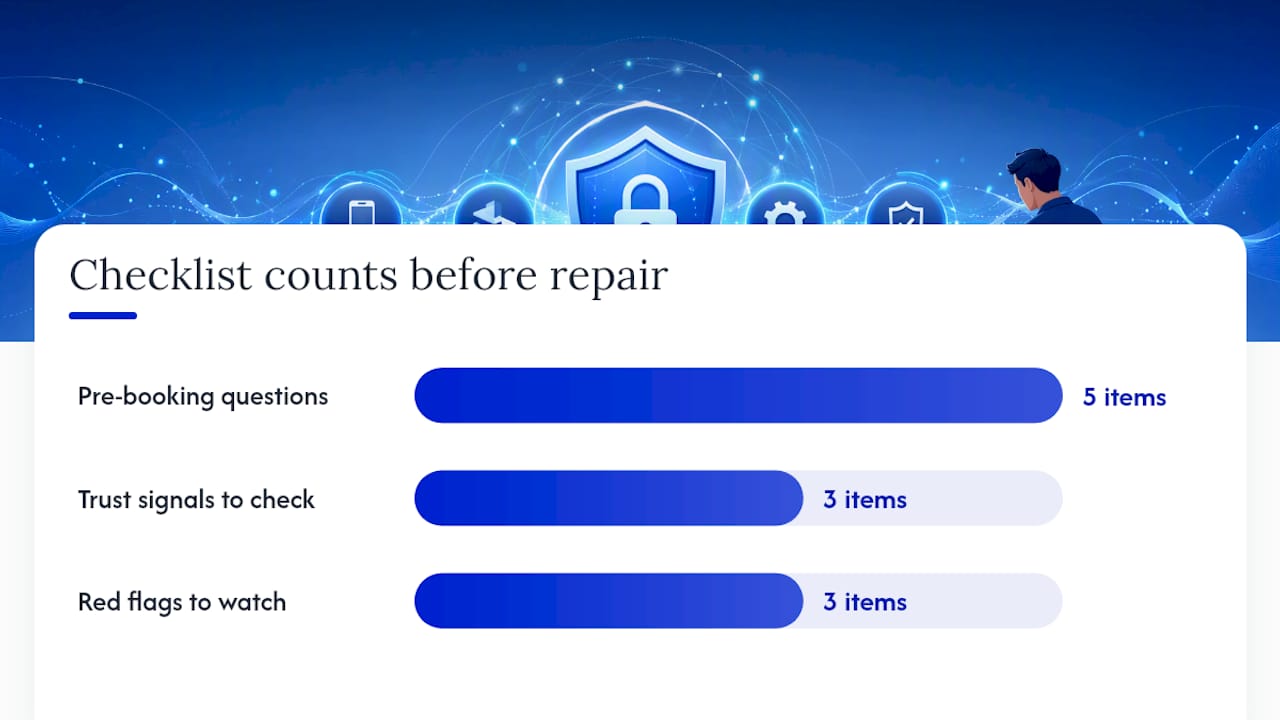
A five-minute phone call before you commit filters out most of the bad options. Run through these questions in order:
- Is there a diagnostic fee, and is it waived if I proceed with the repair?
- What parts warranty do you offer, and does it cover labor too?
- What’s the realistic turnaround for my specific device and issue?
- How do you handle my personal data during the repair?
- What forms of payment do you accept, and is there a deposit required?
Beyond the script, look for three trust signals before you hand over a device. First, a written or itemized quote before any work starts, not a vague verbal number. Second, a visible warranty on both parts and labor, ideally stated in writing, not just claimed over the phone. Third, public customer reviews that mention specifics like turnaround time or communication, not just star ratings with no detail.
Watch for red flags that suggest you should keep looking. A shop that refuses to give any estimate over the phone, even a rough range, is often hiding pricing that varies by how much they think you’ll pay. A technician who can’t explain their data-handling process, or brushes off the question, is a real concern if your device holds banking apps or business files. And a warranty period that’s suspiciously short, like a few days, often signals the shop expects parts to fail.
Pro Tip: If a shop won’t put a warranty in writing before you hand over your device, ask why. A legitimate business has no reason to hesitate.
Checking technician credentials matters more for laptops and computers than for a simple phone screen swap, since certified device repair often involves more complex internal components.
When Does a Repair Need a Specialist or Mail-In Service?
Board-level repair means working directly on a device’s circuit board, replacing individual chips or components with a soldering iron under magnification, rather than swapping a pre-assembled part like a screen or battery. It’s a different skill set entirely, and most walk-in shops don’t keep the equipment or the specialized technicians on staff for it. If your laptop won’t power on, your phone shows water damage deep in the logic board, or a diagnostic reveals a failed charging IC rather than just a worn port, you’re likely looking at board-level work.

Whether board-level repair is worth pursuing usually comes down to a simple math problem: repair cost plus parts needs to sit meaningfully below what a replacement device would cost. Shops typically quote this only after running diagnostics, since the actual failure point determines the price.
Water damage deserves special urgency because what you do in the first five minutes matters. If a device gets wet:
- Power it off immediately and don’t try to turn it back on to “check” if it works
- Don’t plug it in to charge under any circumstances
- Remove the case, SIM card, and any SD card
- Take photos of the device’s condition before you attempt anything else
Skip the rice trick. It does nothing for internal corrosion and can leave dust in your ports. A technician needs to open the device and clean corrosion from the board, which is exactly the kind of job that separates a general repair shop from one equipped for liquid damage recovery.
For complex repairs, ask how the shop documents the process. A good provider notes what they found, what they replaced, and photographs the board before and after. If you’re shipping a device to a mail-in specialist, confirm tracked shipping both ways and get the warranty terms in writing before you box anything up.
Why On-Site Same-Day Repair Changes the Calculation
Most of the friction in electronics repair isn’t the technical work. It’s the logistics: driving to a shop, leaving your phone with a stranger for a day, driving back, and hoping nothing on it got touched that shouldn’t have. On-site repair removes almost all of that.
What stands out most in practice is how much clearer the communication gets when the technician is standing in front of you instead of working behind a counter. You see the diagnostic happen. You hear the actual quote before any part gets touched. You watch your device get repaired instead of wondering what’s happening to it for six hours in a back room.
Some on-site repair services offer same-day service, transparent pricing with no hidden fees, and keep devices in the customer’s sight for the entire repair, which helps address data safety concerns common with phone and laptop repairs. Some repair services provide a warranty on both parts and labor, offering customers added trust in the repair quality.
The decision between on-site and shop drop-off usually comes down to the job itself. A quick screen or battery swap is a natural fit for on-site work. A repair that genuinely needs board-level diagnostics under a microscope might still be better suited to a shop with that specific bench setup. Knowing the difference is most of the battle.
— Michael
Book On-Site Same-Day Repair With Repair Genius
An alternative to shop drop-off repair services is on-site repair, where a technician comes to your home, office, or another location, and handles the repair on the spot with same-day availability in some areas.

Booking repair services typically begins with a call or online request describing the problem. Customers often receive a written, itemized quote before any work begins, an estimated turnaround time (sometimes same-day for common repairs), and may get a warranty on parts and labor after the repair. Repair Genius covers iPhone and Android repairs, iPhone screen and battery service, and on-site computer and laptop repair, all without the hidden fees that make shop estimates hard to trust. If you’re weighing cost against convenience on a tighter budget, this guide to smart phone repair fixes that last is worth a look too.
Ready to get a straight answer on price and timing? Call Repair Genius or book online, and a technician will confirm the diagnostic details before ever touching your device.
Sources
FAQ
Does Geek Squad Fix Electronics?
Geek Squad and similar big-box repair desks handle common consumer electronics repairs, but availability, pricing, and turnaround vary by location and device type. Local independent shops and on-site services like Repair Genius often provide faster turnaround and more transparent, itemized pricing for the same repairs.
Why Are Electronic Repairs So Expensive?
Repair costs reflect parts (especially original-equipment screens and batteries), the technician’s skill level for delicate work like board-level soldering, and diagnostic time. Prices vary widely by device and shop, so calling ahead for a specific estimate on your model gives you a far more accurate number than a general price range.
How Much Does Geek Squad Cost?
Geek Squad’s pricing depends on the device, the specific repair, and your location, and it’s not published as a single flat rate. Repair Genius provides upfront, itemized pricing before any work starts. Current service pricing is available directly through the Repair Genius site.
What Is Someone Who Repairs Electronics Called?
Someone who repairs phones, laptops, tablets, and other devices is generally called an electronics repair technician, or a device repair specialist for more advanced board-level work. Credentialed technicians typically have training specific to the device categories they service, which is worth confirming before you book.
How Do I Know If a Repair Needs Mail-In Service Instead of a Local Shop?
If diagnostics point to a failed component on the motherboard rather than a simple part like a screen or battery, that’s usually board-level work that many local shops route to a mail-in specialist with microsoldering equipment. Ask the shop directly whether they handle board-level repairs in-house or need to send the device out.
Recommended
- How to Transfer Contacts Before Phone Service
- How to Protect Student Data During Device Repair
- When Your Computer Dies: The Repair Rule That Saves Your Data
- Device Repair Checklist for Employees: On-Site Prep Guide