Silica gel is generally more effective than rice for absorbing moisture and is the better choice for storage and protecting electronics. Rice is only a limited, short-term fallback when nothing else is available. For a wet device, both are supplementary at best: if liquid has reached the internals, a professional inspection matters more than any desiccant.
TL;DR:
- Silica gel absorbs significantly more moisture and can be regenerated through heating, making it suitable for long-term storage than rice.
- Rice’s moisture absorption plateaus quickly, and it can leave starch residue and mold risks, especially if left damp for extended periods.
- For a wet device, airflow and professional inspection are more effective than sealing in rice or silica gel packets, which do not remove pooled liquid inside the device.
- Short-term, rice may perform comparably to some commercial desiccants in controlled tests, but silica gel outperforms it in longer or more variable conditions.
- Immediate action on water exposure involves powering off, removing accessories, and letting the device dry in a ventilated area, not burying it in rice.
Table of Contents
- Rice and silica gel compared side by side
- Why silica gel and rice absorb moisture differently
- What the research and real-world tests actually show
- What to actually do with a wet device or a storage box
- The real risks: mold, residue, and overheating
- What years of repair calls have taught us about desiccants
- When drying it out at home isn’t enough
- Where this article’s evidence comes from
- Sources
- FAQ
Rice and silica gel compared side by side
Both materials pull moisture from the air, but they do it at different rates and with different trade-offs. Here is how they stack up on the factors that actually affect a decision.
- Absorption capacity: silica gel can take up water equal to a large share of its own weight, while uncooked rice absorbs far less per gram.
- Speed: silica gel typically pulls moisture out faster across a wider range of humidity levels.
- Reusability: silica gel can be dried out in an oven and used again; rice cannot be meaningfully regenerated as a desiccant.
- Residue risk: rice can shed starch and small grain particles into ports and seams; silica gel leaves nothing behind.
- Cost and availability: rice is cheap and sold everywhere in bulk, while small silica packets are also inexpensive and often already sitting in a kitchen drawer or shoebox.
For long-term storage, silica gel is the clear pick: it keeps working across repeated humidity swings without decomposing. Rice earns its place only in an emergency, when no commercial desiccant is within reach and the item at risk is not something precious. Even then, it is a stopgap rather than a solution, and consumer advice that treats rice and silica gel as interchangeable tends to overstate what rice can do, as a Wikipedia summary of phone-drying practices points out.
Why silica gel and rice absorb moisture differently
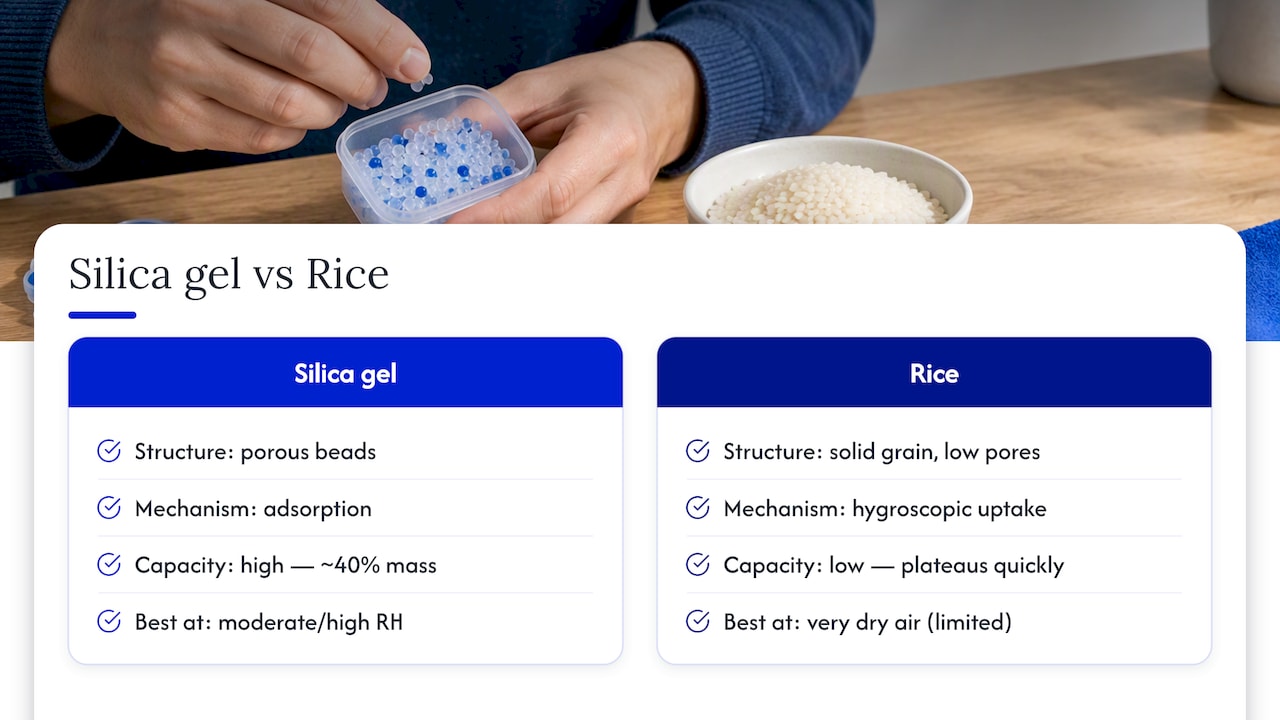
The gap between these two materials comes down to structure. Silica gel is made of tiny porous beads of silicon dioxide, and that porosity is the whole trick: the internal surface area packed into a single bead is enormous compared to its size, giving water vapor a huge number of places to stick. This process is called adsorption, where moisture clings to the surface of the material rather than soaking into it. Laboratory testing on silica gel beds has measured pore volumes in the range of roughly 0.35 to 0.5 cubic centimeters per gram, with some formulations adsorbing water equal to more than 40% of their own mass, according to experimental characterization published in Scientific Reports.
Rice works through a different and weaker mechanism. Grains absorb moisture into their starch structure the way they do during cooking, but a grain of rice does not have anywhere close to the internal surface area of a silica bead. It is a solid, mostly closed structure with limited room for water to enter, so its hygroscopic uptake plateaus quickly and never approaches silica gel’s capacity.
Temperature and relative humidity shift how much this gap matters. Silica gel’s adsorption isotherms, the curves that describe how much water it holds at a given humidity and temperature, show that its advantage is most pronounced in moderate to high humidity, exactly the conditions where moisture control matters most. In very dry air, the difference between the two materials narrows because there is less moisture for either one to capture.
None of this changes the hardest problem with any desiccant: neither rice nor silica gel can pull liquid water out from behind a charging port, under a battery shield, or inside a sealed seam. Adsorption and hygroscopic uptake both work on vapor in the surrounding air, not on pooled liquid trapped in a tight mechanical gap. That distinction is the reason desiccants are a humidity-control tool, not a repair for a device that has already taken on water internally.
What the research and real-world tests actually show
The evidence on rice versus silica gel is more nuanced than most kitchen-counter advice suggests, and it is worth separating the controlled studies from the informal tests.
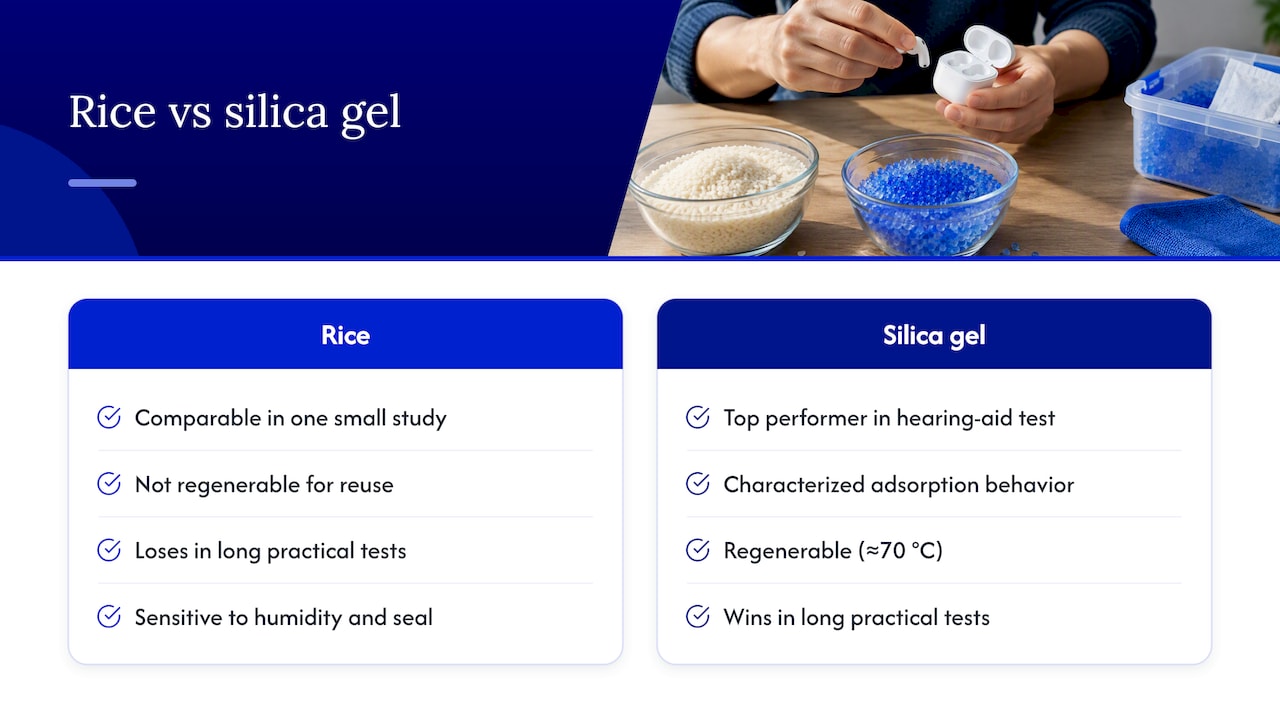
The hearing aid experiment. A 2016 peer-reviewed study compared two behind-the-ear hearing aids, uncooked white rice, and seven commercial desiccants, measuring how each reduced humidity around water-saturated devices. The Hal-Hen Super Dri Aid product produced the largest average reduction, but rice performed comparably to several of the commercial desiccants under those specific test conditions, according to the peer-reviewed PubMed study. That is a real finding, but it comes with real limits: the sample size was small, the test used a narrow set of devices, and the humidity conditions in the test chamber do not represent every climate or every spill scenario. It supports the idea that rice can do something, not that rice matches silica gel in general.
The lab characterization of silica gel. Separate from any head-to-head test, researchers have characterized silica gel’s adsorption and desorption behavior in detail. Fixed-bed reactor experiments show that its capacity shifts with temperature and relative humidity, and that the material can be regenerated by heating, commonly cited around 70 degrees Celsius in some studies, according to the Scientific Reports characterization. This is the property that makes silica gel practical for repeated use in storage, something rice simply cannot offer.
Side-by-side practical tests. Outside the lab, informal but carefully measured comparisons tell a consistent story. Long-duration, weigh-and-measure tests comparing silica gel, bentonite clay, rice, and other materials under identical conditions found that silica gel won by a substantial margin in absorption efficiency, as reported in Hackaday’s coverage of desiccant testing. These tests do not carry the statistical rigor of a peer-reviewed study, but they run longer and under more varied conditions than the hearing aid experiment, and they line up with what the lab characterization data would predict.
The apparent conflict between “rice performed comparably” in one small study and “silica gel wins by a large margin” in longer practical tests is mostly explained by test conditions. Relative humidity, device geometry, how well the container is sealed, and how much desiccant mass is used relative to the air volume all swing the outcome. A rice test with a tightly sealed container, high starting humidity, and a generous mass of rice can look reasonable over a short window; the same setup stretched over days, or repeated across a wider range of humidity, reliably favors silica gel. Consumer explainers covering desiccant sachets make a similar point: silica gel’s nano-porous structure does not degrade the way rice can, which matters for anything stored longer than a day or two, according to The Conversation’s explainer on desiccant sachets.
What to actually do with a wet device or a storage box
The right move depends on whether you are dealing with an emergency (a device that just got wet) or routine prevention (keeping a storage container dry). Treat them as separate problems.
For a device that has just been exposed to liquid:
- Power it off immediately and do not try to charge it. Charging a wet device risks a short circuit.
- Remove the case, SIM tray, and any attached cables or accessories so trapped water can escape.
- Tip and gently shake the device to help any pooled liquid drain from ports and seams.
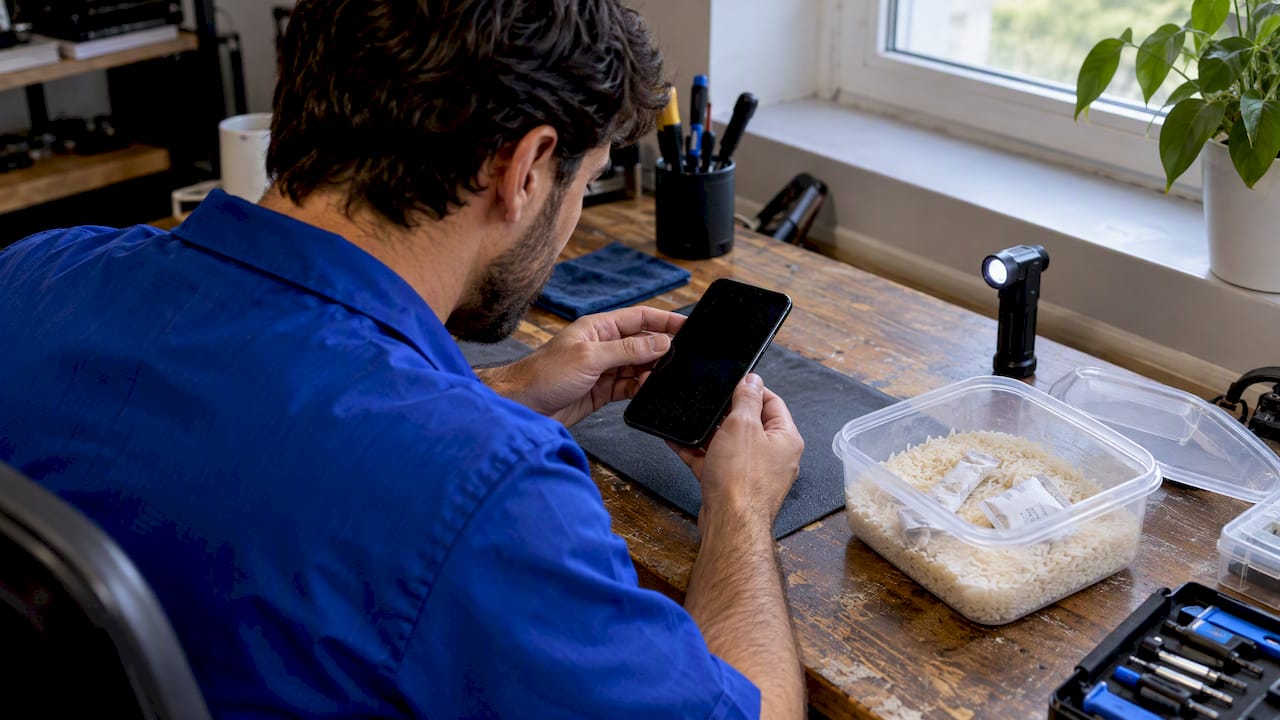
- Set it in a dry, well-ventilated spot with airflow, such as in front of a fan, rather than sealing it inside a container of rice or silica packets.
- Wait before charging. Apple’s own handling guidance recommends waiting at least five hours after liquid exposure before attempting to charge an iPhone, and it does not recommend rice or inserting anything into the ports, according to Apple’s official iPhone handling guidance. Our own step-by-step guide to fixing a water-damaged phone walks through this in more detail, and our water-damaged iPhone tips page covers the iPhone-specific steps.
Pro Tip: Skip the rice entirely for a wet phone or laptop. Airflow and time do more than burying a device in grains that can work their way into the very ports you’re trying to dry.
For storage, desiccants earn their keep differently: they maintain low humidity inside a sealed or semi-sealed container over weeks or months, protecting cameras, documents, tool chests, or spare electronics from mold, corrosion, and fogged lenses. A rough guide used by storage guides is to match desiccant packet mass to container volume and keep the container as airtight as possible, since any gap lets humid air back in. Silica gel packets can be regenerated by spreading the beads on a tray and heating them at a low oven temperature, well under the point where plastic housings or indicating dyes would be damaged. Rice offers no equivalent: once it has absorbed what little moisture it can hold, it is finished. If rice is genuinely the only option on hand, keep it inside a breathable bag rather than loose in the container, so grains and starch dust cannot migrate into the item you are trying to protect.
The real risks: mold, residue, and overheating
Rice left damp for too long can grow mold, and loose grains have a way of working into small openings, leaving starch dust that is difficult to clean out of a port or speaker grille. That residue risk is one of the clearest practical downsides of using rice anywhere near electronics.
Silica gel beads are non-toxic, but they are still a choking hazard for small children and pets and should never be eaten, a point consumer explainers consistently flag even though the beads themselves are chemically inert, per The Conversation’s rundown of what’s inside desiccant sachets. Some indicating silica gel beads use cobalt or other chemical indicators to signal saturation by changing color, and these should be disposed of according to local guidance rather than tossed loosely in household trash.
Regeneration carries its own hazard: heating silica gel near or inside a device, rather than separately on a tray, risks damaging plastics or electronics with excess heat. Follow the manufacturer’s recommended regeneration temperature rather than guessing. If you suspect liquid has reached the inside of a phone or laptop and simple airflow and time have not resolved odd behavior like a flickering screen, unresponsive buttons, or a device that will not power on, that is the point to stop troubleshooting and get it looked at rather than keep experimenting.
What years of repair calls have taught us about desiccants
Desiccants are a humidity tool, not a repair tool, and the sooner people internalize that distinction the better their outcomes tend to be. Silica gel belongs in a camera bag, a tool chest, or a box of old electronics. Rice belongs in the pantry, and only gets pulled into service when someone is caught without a single silica packet and needs to buy a few hours before they can get real help.
What we see less discussed is the false sense of progress rice gives people. A phone that “seems to be drying out” in a bowl of rice often just has grime and starch settling into its ports while the actual liquid behind the screen or near the logic board sits untouched. By the time corrosion sets in, the delay has made the damage worse, not better. If a device has taken on water and still will not boot reliably after a day of airflow, that is corrosion risk building, not a desiccant problem.
— Michael
When drying it out at home isn’t enough
If you have tried the airflow approach and a phone, tablet, or laptop still will not charge, boot, or behave normally, further DIY troubleshooting usually does more harm than good. At that point the safer move is a professional diagnosis rather than a second round of rice or silica packets.

Professional repair services can bring a technician to your location the same day rather than requiring you to ship a device off and wait. That matters most with water damage, where every extra day of corrosion makes the eventual repair more expensive.
- Diagnostic and repair services for phones, tablets, and laptops suspected of liquid exposure.
- Pricing that is communicated upfront.
- Handling practices that aim to protect data throughout the repair.
Professional repair services generally recommend getting a device assessed quickly after water exposure rather than waiting to see if it dries out on its own, a point echoed in Mobile Care USA’s guidance on choosing a repair service. If that describes where you are right now, book a cellphone repair appointment or check our iPhone repair services for the fastest path back to a working device.
Where this article’s evidence comes from
The comparisons above draw on a 2016 peer-reviewed hearing aid study, Apple’s handling guidance for wet iPhones, a Scientific Reports characterization of silica gel adsorption, practical side-by-side desiccant testing from Hackaday, and The Conversation’s explainer on desiccant sachets. Together they cover the lab science, the manufacturer guidance, and the real-world testing behind the verdict above.
Sources
- The effectiveness of commercial desiccants and uncooked rice in removing moisture from hearing aids – PubMed
- Experimental characterization of silica gel adsorption and desorption isotherms under varying temperature and relative humidity in a fixed bed reactor | Scientific Reports
- Desiccants, Tested Side By Side | Hackaday
- ‘Do not eat’: what’s in those little desiccant sachets and how do they work? – The Conversation
FAQ
Can I use rice instead of silica gel?
Rice can act as a short-term emergency fallback when no commercial desiccant is available, but it is not a substitute for silica gel in general. Silica gel absorbs more moisture per gram and does not leave starch residue behind, making it the better choice for storage and for protecting small items.
Does rice actually draw out moisture?
Yes, rice does absorb some moisture through its starch structure, and a 2016 peer-reviewed hearing aid study found it performed comparably to several commercial desiccants in that specific small test. That result does not generalize to every device or climate, and longer practical tests tend to show silica gel pulling ahead over time.
Does rice act as a dehumidifier?
Rice can lower humidity slightly in a small, sealed space around it, but its capacity is limited and it plateaus quickly. It works nothing like a mechanical dehumidifier and falls well short of silica gel for sustained humidity control.
Does putting electronics in rice really work?
Burying a wet phone in rice does not reliably fix the underlying problem, and Apple’s own handling guidance for the iPhone does not recommend rice at all. The better first step is powering the device off, removing accessories, and letting it dry with airflow, as covered in Apple’s handling guidance, followed by professional inspection if problems persist.
Recommended
- At Home Phone Repair: DIY vs. Professional Options
- How to Fix a Water Damaged Phone
- Expert Device Repair: Find Certified Pros Fast in the US
- Why Device Repairs Fail: Common Mistakes Explained