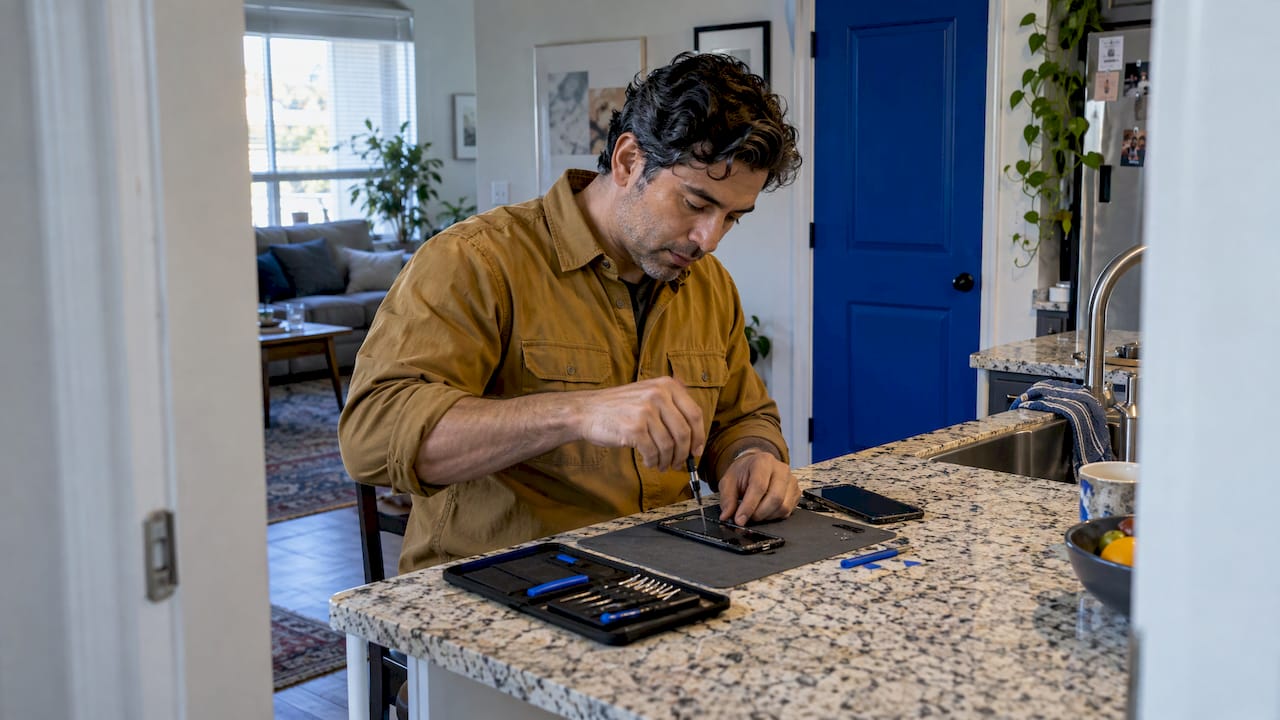
For phones, tablets and laptops, repairing is usually the lower-impact choice. Most of a device’s footprint is created before you ever turn it on, when it is mined, manufactured and shipped. Fixing a cracked screen or a tired battery keeps all of that in use. Buying new starts the clock over. If your device is broken today, the greenest move is typically a good repair done once, done right and done quickly, which is what our technicians do at your home, office or campus in Orlando and Winter Park.
TL;DR
- Most of an electronic device’s lifetime emissions come from making it, so keeping it longer is the biggest lever you control.
- In one 2021 life-cycle study, repairing a smartphone cut its global-warming impact by 71% compared with a new phone.
- Extending a product’s life by 50% cuts the replacements needed, and their environmental impact, by about a third, according to NIST.
- Repair also tends to cost less than buying new, so the green choice and the budget choice often match.
- A quick, warranty-backed on-site repair is the practical way to make that choice without losing a day of work or study.
Table of Contents
- Why the footprint of a device is mostly in the making
- What the numbers say about repair
- The waste side of the story
- Repair, refurbish, replace: the differences
- What makes a repair worth it, environmentally and financially
- Why the reason people replace matters
- Special cases by reader
- How to make the repair choice in five steps
- Why on-site repair adds to the case
- Our perspective
- Ready to fix it instead of replacing it
- FAQ
- Sources
Why the footprint of a device is mostly in the making
People often assume a phone’s environmental cost comes from charging it. For most electronics it is the opposite. A 2022 peer-reviewed study of ICT devices found that embodied carbon from mining, manufacturing and supply chains accounts for 67% ± 15% of their total lifetime emissions. Embodied carbon simply means the emissions already baked into the product by the time you buy it.
U.S. PIRG, a consumer research group, makes the same point: mining and manufacturing electronics can use more energy than running the product over its whole life. That is why building products that last and are easy to fix reduces the number of new devices that have to be made.
The American Bar Association’s 2023 article on right to repair describes the same logic from a policy angle: keeping products usable longer avoids the production and distribution emissions of the take-make-waste system.
So the question “repair or replace?” is really “do I want to pay the manufacturing footprint again?”
What the numbers say about repair
Three figures are worth knowing.
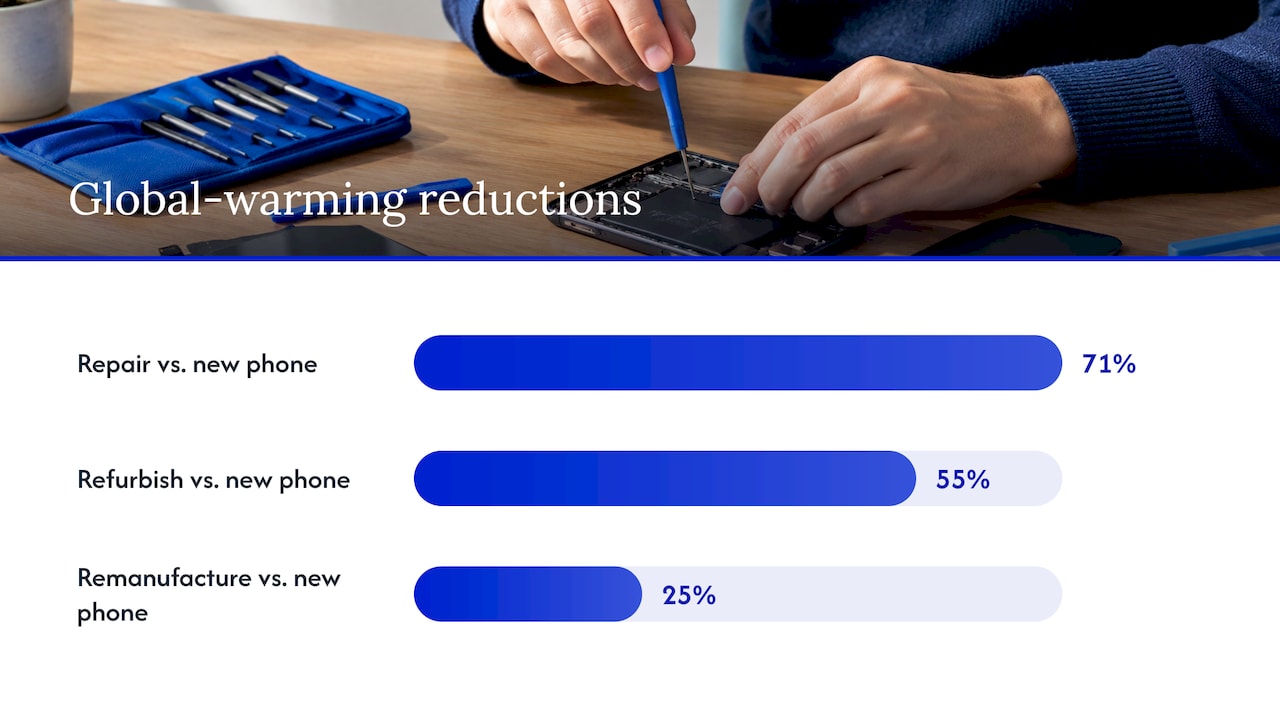
Smartphones. A 2021 study in the International Journal of Life Cycle Assessment compared circular options for phones. Repair showed the smallest impact of all of them, cutting global-warming potential by 71% versus a new phone. Refurbishing cut it by 55% and remanufacturing by 25%. The benefit was even larger for mineral depletion, because the metals already inside the phone stay in use.
Longer life. NIST, the federal measurement agency, estimates that a 50% increase in a product’s life expectancy decreases needed replacements and their environmental impacts by roughly 33%, and a 100% increase by 50%, assuming products are used to the end of their life.
One extra year. A Green Alliance report on smart devices found that extending a device’s life by a year cuts its lifetime CO2 impact by a third. The same report found that repair makes economic and environmental sense for at least four years of a device’s life and up to seven, and that replacing the screen and battery on a longer-lived iPhone still cut carbon by 46%.
A quick worked example: a phone that would normally be replaced after three years but is repaired and used for four and a half has had its life extended by 50%. On NIST’s math, that is about a third fewer phones needed over time.
The waste side of the story
The environmental case is not only about carbon. Electronics waste is one of the fastest-growing waste streams, and the U.S. contribution is large.
- U.S. PIRG reports that the average American family generates about 176 pounds of electronic waste per year, and that discarded electronics add lead, mercury and cadmium to landfills.
- A 2023 rulemaking petition citing a UN report states that Americans discard 416,000 cellphones every day, and that even when electronics are recycled, about 30% of the materials are lost and cannot be reused.
- The 2022 study mentioned above found that average useful lifespans fell by 41% for desktops, 22% for laptops and 30% for smartphones between 2013 and 2020.
Recycling matters, but it comes after repair in the order of preference. Recycling recovers some material, while repair keeps the whole device, with everything that went into it, working.
Repair, refurbish, replace: the differences
These words get mixed up, and the difference affects both cost and footprint.
| Option | What it is | Typical environmental result |
|---|---|---|
| Repair | Restoring your own broken device by replacing the failed part | Smallest impact; in the 2021 phone study, a 71% cut in global-warming potential versus new |
| Refurbish | Reconditioning a used phone for a new owner | Large saving: 55% in the same study |
| Replace with new | Manufacturing and shipping a new device | Highest impact, since most emissions occur in production |
The same study treats repair as restoring a broken phone, and refurbishing as reconditioning used phones for new users. If your phone is yours and the problem is one part, repair keeps you on a device you already know, with your data and settings in place.
What makes a repair worth it, environmentally and financially
The research gives a clear picture of what drives the result. You do not need a spreadsheet, just four questions.
How old is the device, and is it still supported?
The earlier in a device’s life a repair happens, the more extra years you get for the footprint the repair adds. The Green Alliance window of four to seven years is a handy guide. Extending life only pays off when the device keeps performing well and receiving software updates. Researchers note that buying a new complementary device defeats the e-waste reduction goal, so the aim is to repair the device you actually use every day.
Which part failed?
The most common failures are the ones repair handles best. In a U.S. survey, cracked screens and dead batteries were the most common reasons people replaced a phone or tablet. Both are routine repairs. We replace screens and batteries on iPhones, Samsung and other Android phones, iPads and laptops. For battery questions in particular, our guide to iPhone battery replacement vs. buying new walks through the decision.
What does the repair cost against a new device?
Cost and carbon usually point the same way. U.S. PIRG estimates that repairing instead of replacing could cut household spending on electronics and appliances by 22%, about $330 a year for the average family. Screens show the spread clearly: a law journal article reports that a third-party iPhone X screen can cost as little as $30, against Apple’s $279 repair fee. Our phone repair vs. replacement cost guide goes deeper on the money side.
How many times will it be repaired?
A 2023 Journal of Industrial Ecology study found that typical phone and tablet repairs save substantial CO2e and water versus manufacturing a new device, and that the savings vary by which component is repaired, with displays and cameras carrying more impact than other parts. The practical takeaway is to fix the problem properly the first time, with quality parts and a warranty, so that one repair carries the device through its remaining life.
Why the reason people replace matters
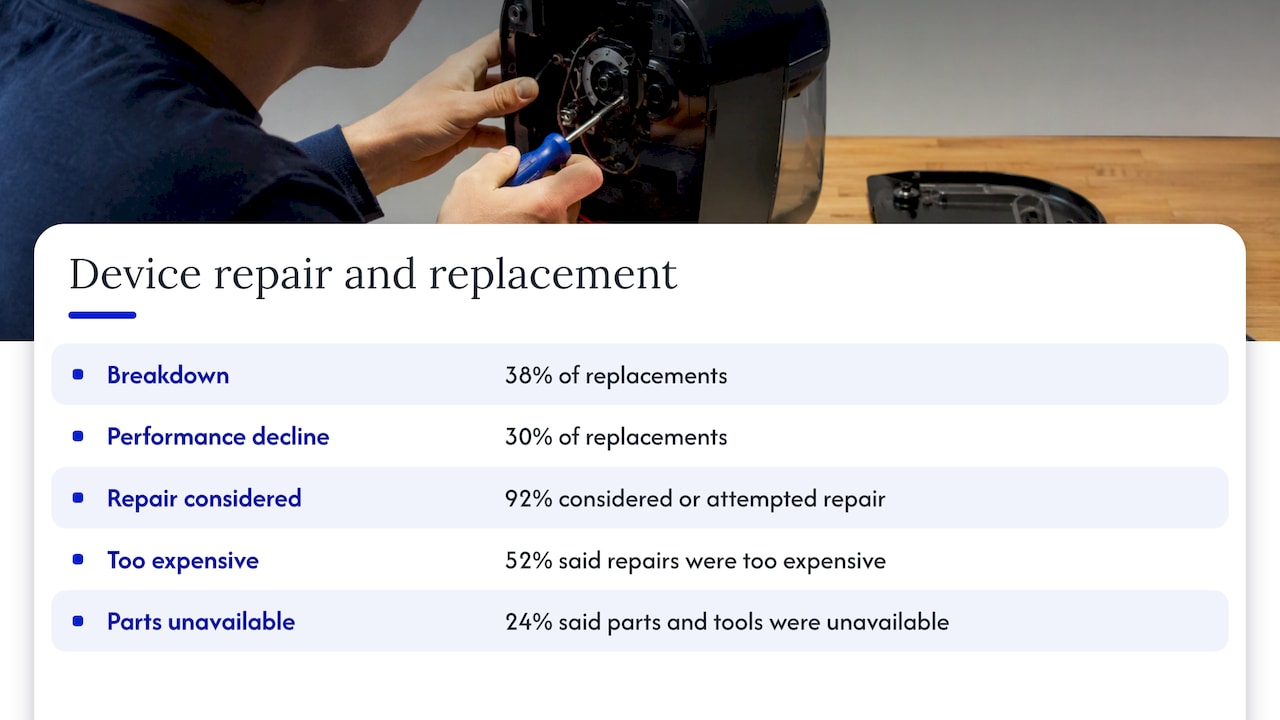
NIST reports that breakdown is the most common reason consumers replace a digital device (38% of replacements), followed by performance decline (30%). In that same survey of phone and tablet owners, 92% had considered or attempted a repair, but 52% said repairs were too expensive and 24% said parts and tools were unavailable.
Those are the obstacles that stop a repair from happening, and they are practical ones: price uncertainty, access to parts, and the time to drop a device off somewhere. They are solvable. We quote the price up front, with no hidden fees, source the parts, and come to you, so the repair doesn’t cost you a trip across town or a day without your device.
Special cases by reader
Busy professionals
A dead phone is a lost day. Repair has a convenience edge here: you keep your number, apps, authenticator codes and photos exactly as they are, with no migration to a new device. Our same-day, we-come-to-you phone repair is built around that.
Students
A laptop is the most expensive thing many students own, and replacing it mid-semester is rarely planned for. Our student laptop repair vs. replace guide and the laptop repair before replacement checklist lay out what to weigh before spending on a new machine.
Parents
Kids’ tablets and phones crack, swell and drown. Water damage recovery, screen repair and battery work can all be done at home while you get on with your day. A swollen tablet battery in particular needs prompt attention, covered in tablet screen repair and swollen battery risks.
Small business owners
A fleet of laptops and phones is both a cost line and an environmental footprint. Tracking device age, failures and replacement timing is the core of hardware lifecycle management with KPIs, and repairing devices mid-life fits naturally into that plan. See also why employee devices need quick repair so work doesn’t stall.
How to make the repair choice in five steps
- Name the failure. Cracked screen, short battery life, bad charging port, water exposure, slow or infected computer. Each has a standard repair.
- Check the device’s age and support. If it still receives software updates and runs your apps well, it is a strong repair candidate.
- Get a written quote before any work starts. Our quotes are given up front, covering diagnostics, labor and parts, with no hidden fees.
- Back up and protect your data. We prioritize data safety during repairs; a fresh backup is still good practice, and our guide to encrypting local backups before repair shows how.
- Choose a repair with a warranty on parts and labor. One properly done repair is the greener path, and a warranty is what makes it a one-time event.
Why on-site repair adds to the case
Most of the savings in this article come from keeping the device itself. How the repair is delivered adds a smaller but real benefit: our technicians travel to your chosen location in Orlando or Winter Park, so you don’t make a round trip to a shop or ship a device and wait. Repairs are performed at your location, and our certified technicians handle advanced board-level repairs as well as common fixes like screens, batteries and charging ports. Compare how this works in practice in our on-site vs. repair shop breakdown.
Our perspective
We built Repair Genius on a simple idea: most broken devices are one failed part away from working again, and the owner should not have to give up a day, or their data, to get that part replaced.
The research backs what we do every day. The footprint of a phone or laptop is overwhelmingly in its manufacture, so the best thing a person can do for the environment is keep the device they already own working for as long as it serves them. That is also usually the less expensive path.
What people tell us they want is clear pricing, honest diagnostics and a fix that lasts. With more than 10 years of experience, that is what we aim to deliver: a quote before work begins, quality parts, a warranty on parts and labor, and care for your personal information throughout.
If a device is still doing its job except for one fault, repair it. You keep your setup, you keep your money, and one more device stays out of the waste stream.
Michael
Ready to fix it instead of replacing it
If your phone, tablet or laptop has a fault, book a repair and we will come to you in Orlando or Winter Park. We repair iPhones, Samsung and other Android phones, iPads and tablets, and Windows computers and laptops, as well as MacBooks and iMacs, with same-day service.

Pricing is quoted up front, covering diagnostics, labor and parts. See the full range on our site.
FAQ
Is it cheaper to repair or replace an iPhone?
For the common faults, such as a cracked screen or a worn battery, repair usually costs less than a new phone. U.S. PIRG estimates repair-first habits could cut household electronics spending by 22%. Our iPhone repair services come with an up-front quote so you can compare it with the price of a new phone before deciding.
What is the difference between repair and refurbish?
Repair restores your own broken device by replacing the failed part. Refurbishing reconditions a used device so a new owner can use it. Both beat buying new, but repair keeps your data, settings and accessories in place.
Does repairing a phone really help the environment?
Yes. In a 2021 life-cycle study, repairing a smartphone cut its global-warming potential by 71% compared with a new phone, because most emissions come from production. Keeping the device in use avoids that production footprint and also keeps its metals in circulation.
How long should I keep a device before replacing it?
There is no single number, but the Green Alliance found repair makes economic and environmental sense from four to seven years of device life. The better test is whether the device still runs well, gets software updates and has one fixable fault. If so, repair is the efficient move.
Can repairs be done at my home or office?
Yes. We perform repairs at the location you choose in Orlando and Winter Park, including phones, tablets, laptops and business devices. Same-day service is part of how we work.
Sources
- Modelling of different circular end-of-use scenarios for smartphones (Int. J. Life Cycle Assessment, 2021)
- NIST: Circular Economy, Product Longevity
- American Bar Association: Right to Repair and the Environment
- U.S. PIRG: The environmental benefits of repair
- Disentangling the worldwide web of e-waste and climate (2022)
- Green Alliance: A circular economy for smart devices (2021)
- U.S. PIRG: Repair Saves Families Big (2021)
- Petition for Rulemaking (Public Interest Network, 2023)
- Consumer Perceptions of the Right to Repair (Indiana Law Journal, 2021)
- Carbon and water conservation value of independent repair (Journal of Industrial Ecology, 2023)
Recommended
- Device End-of-Life Repair: What You Need to Know
- Phone Repair vs Replacement Cost: 2026 Decision Guide
- Laptop Repair Before Replacement Checklist 2026
- iPhone Battery Replacement vs Buying New