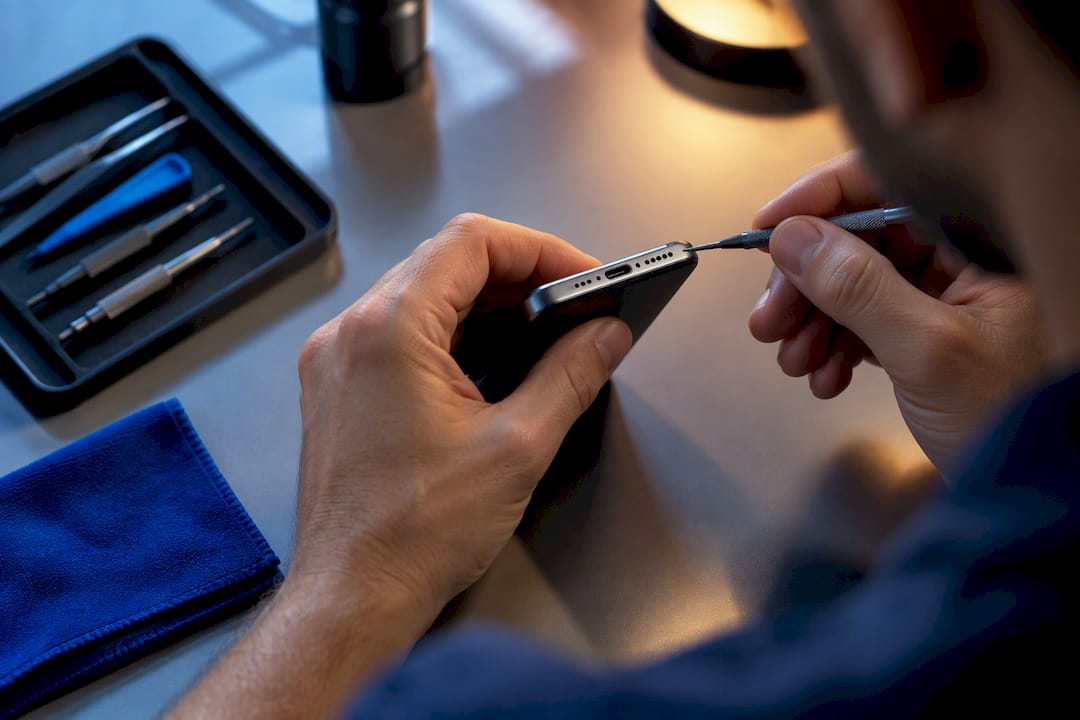
Using an independent repair shop does not automatically void your device’s manufacturer warranty. Third-party repair warranties are real and common: most independent shops back their own work with a parts-and-labor guarantee, typically lasting 30 to 90 days. Federal law also protects you at the manufacturer level. Under Magnuson-Moss and current FTC guidance, a manufacturer can’t cancel your warranty just because someone else touched your phone, but it can still refuse to cover damage that repair actually caused.
TL;DR:
- Independent repair shops typically offer warranties lasting 30 to 90 days on parts and labor, with coverage varying based on the component and shop policies.
- Federal laws protect your warranty rights, preventing manufacturers from voiding coverage solely because a third-party shop performed the repair, unless they can prove the damage was caused by it.
- It’s crucial to obtain written warranty terms, device identifiers, and details on parts used before authorizing a repair to support any future disputes.
- Manufacturer denial of warranty based solely on using an independent shop is illegal, but damages caused during the repair can justify a refusal of coverage for that specific issue.
- Repair shops that document the process thoroughly and provide transparent quotes help ensure quicker resolution if a warranty claim is disputed.
Table of Contents
- What Does a Third-Party Repair Warranty Actually Cover?
- Does an Independent Repair Void Your Manufacturer Warranty?
- What to Ask a Repair Shop Before You Say Yes
- If Your Warranty Claim Gets Denied, Here’s What to Do
- How Long Does a Third-Party Repair Warranty Claim Take?
- What Does a Third-Party Repair Warranty Actually Cost You?
- Why Documentation Is the Real Warranty Protection
- Get a Warranty-Backed Repair Without the Mail-In Wait
- Where to Verify Your Warranty Rights
- Sources
- FAQ
What Does a Third-Party Repair Warranty Actually Cover?
A repair shop’s warranty is a separate promise from anything Apple, Samsung, or Google offers on the device itself. It’s the shop guaranteeing its own labor and the parts it installed, and it usually breaks down into three pieces.
The parts warranty covers the physical component. If a shop replaces your iPhone screen and the digitizer stops responding two weeks later, the parts warranty should cover a free replacement. The labor warranty covers the workmanship itself. If a charging port repair loosens and stops making contact because of how it was installed, that’s a labor issue, not a parts issue, and a good shop treats it the same way. The remedy clause spells out what actually happens when something goes wrong: repair, replace, or refund. Reputable shops put this in writing before you ever hand over your device.
Duration varies by shop and part type. A battery replacement warranty might run shorter than a screen warranty simply because batteries degrade naturally and shops need a way to distinguish normal wear from a defective part. Most independent phone repair warranty terms usually last a few weeks to a few months, roughly aligning with typical manufacturer electronic repair warranty periods.
Exclusions matter just as much as coverage. Standard carve outs include:
- Accidental damage after the repair, like a new drop or crack
- Liquid or water damage introduced after the device left the shop
- Pre-existing defects unrelated to the repaired component
- Cosmetic issues that don’t affect function
OEM parts and aftermarket parts often carry different warranty lengths, and a shop should tell you which one it’s using before the repair starts. Get the warranty terms in writing, tied to your invoice. Without a paper trail, “the shop guaranteed it” becomes your word against theirs.
Does an Independent Repair Void Your Manufacturer Warranty?
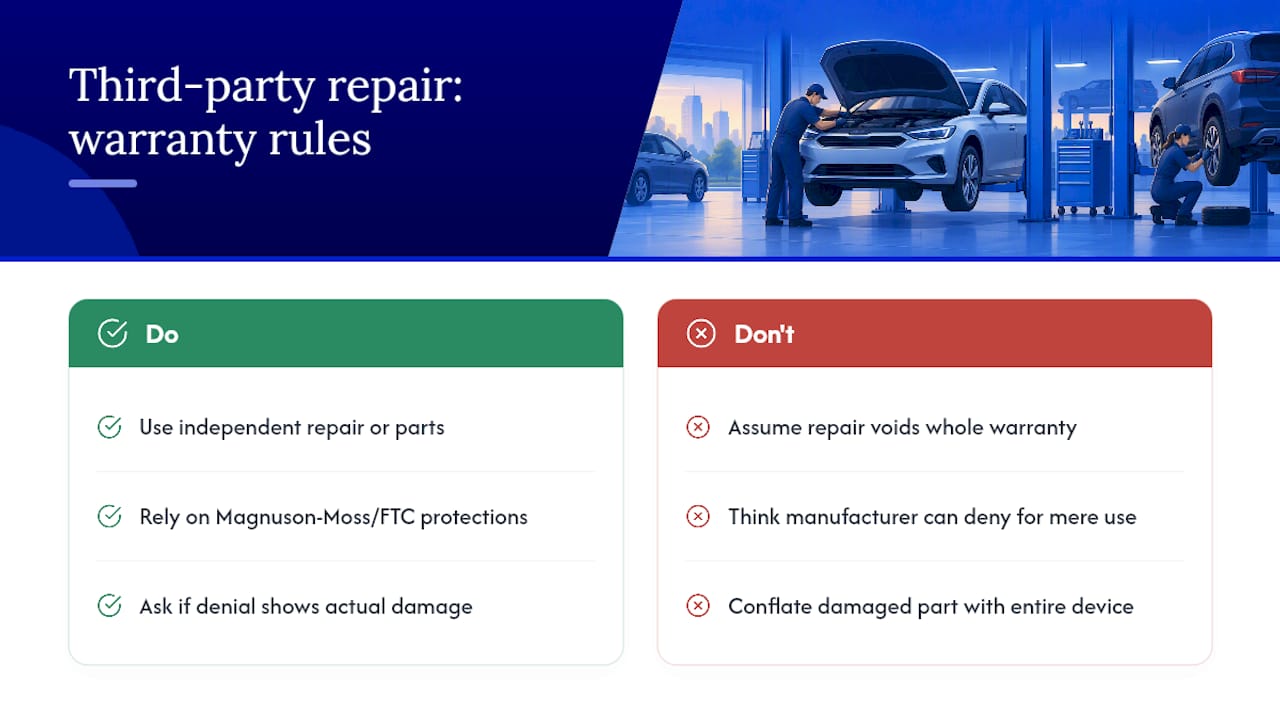
Generally, no. The Magnuson-Moss Warranty Act includes an anti-tying rule that stops manufacturers from conditioning warranty coverage on the use of their own parts or authorized service, unless those parts or services are provided free of charge. That’s the legal backbone behind every “does third-party repair void my warranty” question.
The FTC has backed this up directly. Its consumer guidance states plainly that companies can’t void a warranty just because a consumer used an independent repair shop or aftermarket parts, and in 2024, the FTC warned companies to stop warranty practices that mislead people into thinking their coverage disappears the moment a non-authorized technician opens the device.
Manufacturers cannot deny warranty coverage simply because a repair or replacement part came from somewhere other than the original company, unless they can show that specific outside part or service actually caused the problem.
That’s the line the FTC itself has drawn in its consumer alert on illegal warranty restrictions, and it traces back to interpretive rules the agency finalized on the Magnuson-Moss Warranty Act governing tying arrangements and warranty disclosures.
The exception is narrower than most people assume. A manufacturer can lawfully deny coverage when it can point to actual damage the unauthorized repair caused. Say an independent shop replaces your cracked screen. If the battery fails on its own six months later, that’s typically still covered under your Samsung warranty after repair, because the battery has nothing to do with the screen work. But if the shop nicked the battery connector during that same repair, and the battery later fails because of that damage, the manufacturer has grounds to deny that specific claim. The warranty on the rest of the phone usually stays intact. It’s the damaged component, not the whole device, that’s at risk.
What to Ask a Repair Shop Before You Say Yes
Protecting your warranty rights starts before the repair, not after something goes wrong. Walk through this checklist with any shop you’re considering, whether it’s a walk-in storefront or an on-site technician who comes to you.
- Get a written work authorization. It should list your device’s serial number or IMEI, its condition before the repair, and exactly what work is being done.
- Ask for the warranty terms in writing. Length, what’s covered (parts, labor, or both), and what the shop will do if something fails.
- Find out what parts they’re using. OEM, high-quality aftermarket, or generic, and get the brand or model noted on your receipt.
- Ask how they handle your data. Whether they back anything up, and what happens to your information during the repair.
- Ask if they keep the old part. Some shops return it, some don’t, but you should know which before they start.
- Request before-and-after photos. These matter if a dispute ever comes up later.
- Get the technician’s name and an estimated completion time, along with a written note of anything the shop says it won’t touch.
Pro Tip: Ask the shop directly, “What will you do if the manufacturer denies a related claim later?” Their answer, and how quickly they give it, tells you a lot about whether they’ll actually stand behind the repair.
If Your Warranty Claim Gets Denied, Here’s What to Do
A denial isn’t automatically the final word, but you need paperwork to fight it. Start pulling together everything connected to the repair the moment a manufacturer pushes back.
- Gather your original invoice, the shop’s written warranty, before-and-after photos, and the old part if you still have it.
- Ask the manufacturer to put the denial in writing and explain, specifically, what damage they’re pointing to and what evidence supports it.
- If the denial seems to rest entirely on “you used an independent repair shop” with no actual damage evidence, that’s the kind of practice the FTC wants reported through ReportFraud.ftc.gov.
- Your state consumer protection office is another option, and small claims court can work for larger disputes, though it’s worth weighing the time involved against what you’d actually recover.
Right-to-repair laws in states like California and Minnesota are also changing the picture. Consumer Reports notes these laws are pushing manufacturers to make parts, tools, and documentation more available to independent shops, which gives you a stronger paper trail if a dispute lands in front of a regulator.
How Long Does a Third-Party Repair Warranty Claim Take?
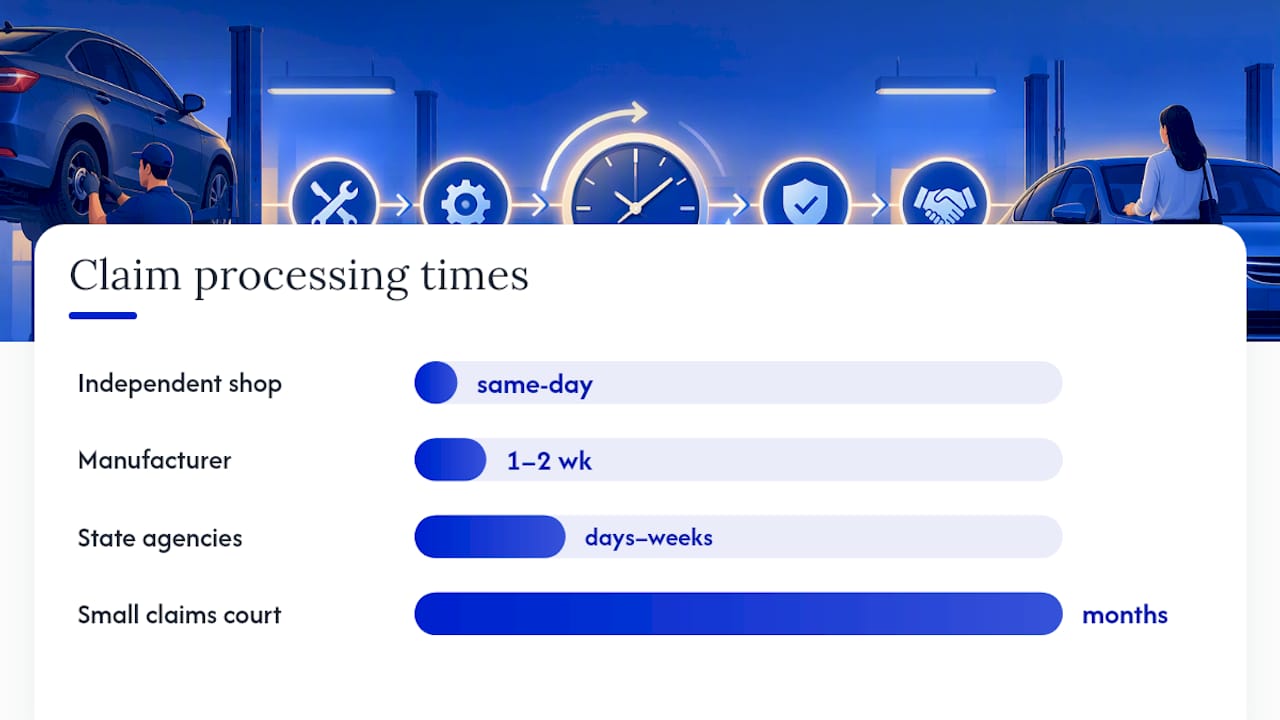
Filing a claim with an independent shop is usually faster than dealing with a manufacturer directly. Most shops ask you to bring the device back, walk through what’s wrong, and compare it against your original invoice and warranty terms. If the shop agrees the issue falls under warranty, many resolve it same-day or within a few business days, since they already have your repair history on file and often the same technician who did the original work.
Manufacturer-side disputes move slower. Samsung and Google typically process warranty claims within one to two weeks, though a disputed claim involving a prior independent repair can stretch longer while they review evidence. Apple’s retail repair terms outline similar service windows for its own repairs, and those timeframes provide some indication of typical manufacturer repair processing times.
Escalation adds time. A ReportFraud.ftc.gov complaint doesn’t resolve your individual case quickly. It feeds into broader enforcement patterns. State consumer protection offices vary widely, some responding within days, others taking weeks just to open a file. Small claims court is the slowest path by far, often months from filing to hearing. That’s exactly why the checklist earlier in this piece matters so much: a shop that hands you clean documentation up front can shrink a multi-week manufacturer dispute down to a phone call with a receipt attached.
What Does a Third-Party Repair Warranty Actually Cost You?
Most independent shops build the parts-and-labor warranty into the repair price rather than charging extra for it, which is one real advantage over manufacturer extended plans that often carry a separate monthly or annual fee. Your repair estimate should already include coverage for a defective part or a labor mistake within that shop’s stated window.
Where costs do show up is in the fine print around what triggers a charge. Some shops apply a deductible or reduced fee if you need a second repair on the same issue, particularly if it’s outside the strict 30 to 90 day window. Diagnostic fees are another spot to watch. A few shops waive them if you proceed with the repair but charge $20 to $50 if you walk away, and that policy should be disclosed before you agree to anything. Rush service or on-site travel fees are separate line items entirely and shouldn’t be confused with warranty terms.
The real cost risk isn’t the warranty itself. It’s an exclusion that surfaces after the fact: a shop that quietly limits its liquid-damage coverage or aftermarket parts guarantee to a fraction of what it originally implied. That’s why asking for warranty terms in writing before the repair, not after, is the cheapest insurance you’ll get in this whole process. A five-minute conversation up front beats a fee dispute two months later.
Why Documentation Is the Real Warranty Protection
Most warranty disputes don’t come down to who’s technically right under the law. They come down to who has better paperwork. That’s the piece people underestimate most about third-party repair warranty coverage: the law is already on your side in the vast majority of cases, but proving what actually happened during a repair is where claims fall apart.
Repair Genius builds documentation into every on-site job as standard practice, not as an afterthought. That means a written work authorization, device identifiers recorded up front, part receipts, and before-and-after photos, the same habits described in the checklist above. Same-day, on-site service also cuts out a real risk factor: the multi-week mail-in gap where a device sits in unknown hands and unknown conditions, making any later dispute about what caused what almost impossible to untangle. Ten-plus years of on-site repair work and transparent, upfront pricing back that approach, along with a straightforward parts and labor warranty on every job. Good documentation isn’t just for disputes with manufacturers. It’s what lets you trust the shop in the first place.
— Michael
Get a Warranty-Backed Repair Without the Mail-In Wait
Skip the shipping box and the two-week wait. Repair Genius comes to you in Orlando and Winter Park, backs its parts and labor with a written warranty, and quotes the price before any work starts, so there’s no surprise fee buried in the invoice.

Whether it’s a cracked screen, a battery that won’t hold a charge, or a laptop that won’t boot, the same documentation habits covered above apply to every job: written authorization, device identifiers on file, and photos before and after. That’s what makes a warranty claim, if you ever need one, a quick conversation instead of a fight. Same-day appointments mean your phone or laptop isn’t out of your hands for a week while you wait to find out if it’s fixed. If your phone needs attention now, get a same-day cellphone repair quote, and if it’s a laptop or desktop giving you trouble, book on-site computer repair and have a technician at your door instead of your device in a box.
Where to Verify Your Warranty Rights
- The FTC’s 2024 press release lays out current enforcement priorities against illegal warranty tying.
- The FTC consumer alert explains your rights in plain language and where to report violations.
- Consumer Reports’ right-to-repair coverage tracks which states are expanding access to parts and documentation.
Sources
- FTC press release: FTC warns companies to stop warranty practices that harm consumers’ right to repair
- FTC consumer alert: ‘FTC says companies’ warranty restrictions were illegal’
- Consumer Reports: Right‑to‑repair laws make electronics easier to repair
FAQ
Does Using a Third-Party Repair Shop Void My Warranty?
No, not automatically. Federal guidance from the FTC prevents manufacturers from voiding a warranty solely because you used an independent shop, though they can deny coverage for damage that specific repair caused.
How Long Do Independent Repair Shop Warranties Usually Last?
Most repair shop warranties run 30 to 90 days, covering both the part installed and the labor performed. Always get the exact length and terms in writing before the repair starts.
What Should I Get in Writing Before an Independent Repair?
Ask for a written work authorization listing your device’s serial number or IMEI, the warranty length and coverage, and details on the part brand being used. This paperwork becomes essential if you ever need to dispute a denied claim later.
Does Repair Genius Offer a Warranty on Its Repairs?
Yes, this repair service backs on-site repairs with a parts and labor warranty and provides transparent, upfront pricing before any work begins. Details are available through the cellphone repair and computer repair service pages.
What Should I Do if a Manufacturer Denies My Warranty Claim?
Request a written explanation identifying the specific damage the manufacturer is pointing to as the reason for denial. If the denial rests only on the fact that you used an independent shop, report it through ReportFraud.ftc.gov and consider contacting your state consumer protection office.
Recommended
- What Is a Device Repair Guarantee? 2026 Guide
- How Repairs Shape Device Resale Value in 2026
- How to Protect Student Data During Device Repair
- Is Your Damaged Phone Worth Fixing? A Clear Guide