
Repair turnaround time is the total elapsed time from when a device gets dropped off or diagnosed to when it comes back working. Simple fixes like screen and battery swaps usually clear the same day, often in under an hour once parts are on hand. Water damage and board-level faults stretch into multiple days, and anything requiring shipped parts or a mail-in program can take multiple business days. The band you land in depends almost entirely on parts availability and repair complexity, not luck.
TL;DR:
- Same-day repairs usually take 30 to 90 minutes once parts are available, but complex issues like water damage or board repairs can extend to several days.
- Shipping and centralized queuing significantly lengthen mail-in repair timelines, often reaching 5 to 10 business days before work begins.
- Parts availability is the key driver of repair speed; stocking the most common components can halve wait times.
- Operational factors such as technician workload, diagnostics complexity, and scheduling greatly impact how long a repair takes, sometimes stacking delays.
- On-site, same-day repair services eliminate shipping and drop-off delays, making them optimal for urgent device fixes, especially for essential business equipment.
Table of Contents
- What Repair Turnaround Time Means and Why It Matters
- How Long Does Phone Repair Take? Benchmarks by Repair Type
- What Actually Determines Repair Process Duration
- Six Tactics That Actually Shorten Turnaround Time
- Local Shop, Authorized Center, or Mail-In: Speed vs. Warranty
- What to Ask at Intake to Avoid Delays
- How On-Site, Same-Day Repair Changes the Turnaround Math
- Speed Matters, But Not at Any Cost
- Get a Fast, Honest ETA From Repair Genius
- Sources
- FAQ
What Repair Turnaround Time Means and Why It Matters
Repair turnaround time, or RTAT, measures the clock from intake to return. It’s a close cousin of MTTR (mean time to repair), a term borrowed from manufacturing and IT operations that measures the average time to fix a failed system. The two overlap heavily, but RTAT usually includes the customer-facing steps, like scheduling and pickup, that a pure bench-repair metric skips.
For an individual, a slow RTAT means days without a phone, a laptop, or a tablet that work depends on. For a business, it compounds fast. A single employee sidelined by a cracked laptop screen isn’t just inconvenienced. Every hour that device sits on a shelf is an hour of lost output, missed calls, or a stalled project, and the effect multiplies across a team. That operational cost is exactly why device downtime matters more than most companies budget for when they’re planning IT support.
There’s a consumer protection angle too. The Magnuson-Moss Warranty Act shapes how repair providers and manufacturers have to communicate warranty terms and repair expectations, which is part of why reputable shops give you a written estimate rather than a vague “we’ll call you.” A few things worth knowing before you drop off a device:
- RTAT typically starts at intake or diagnosis, not at the moment the device actually breaks.
- Warranty repairs often carry different timelines than out-of-warranty ones because of authorization steps.
- A quoted “estimate” isn’t a guarantee. It’s a band based on typical cases, and yours might not be typical.
How Long Does Phone Repair Take? Benchmarks by Repair Type
Turnaround splits cleanly into three bands, and knowing which one your repair falls into tells you almost everything about what to expect.
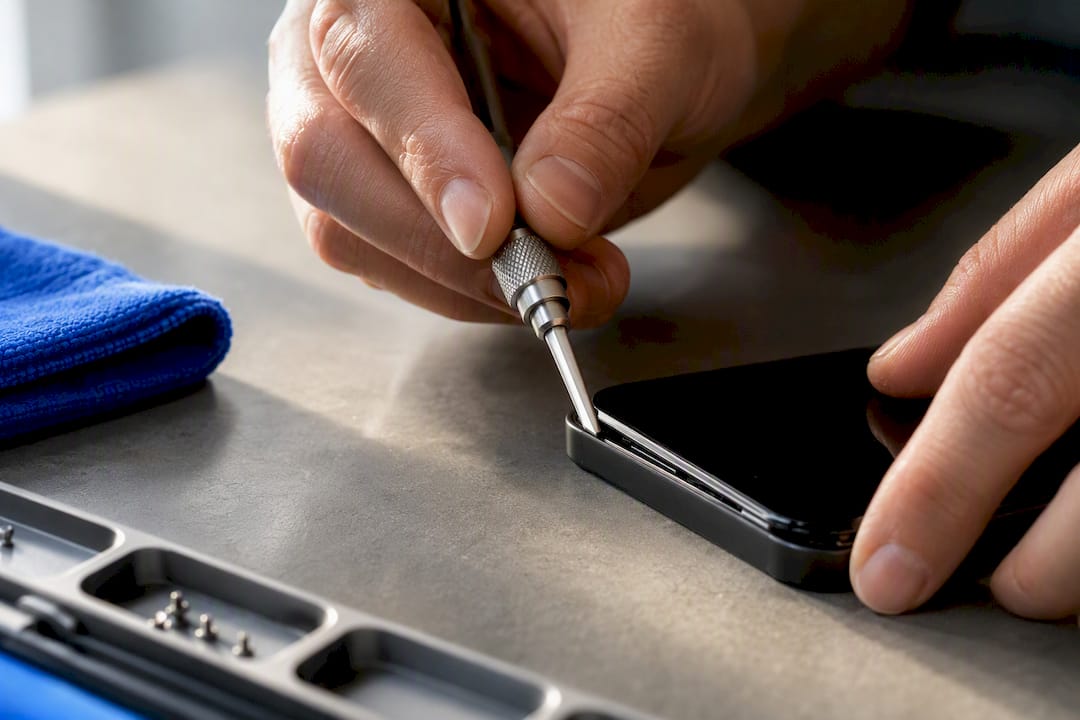
Same-day repairs cover the bulk of common fixes. Screen replacements, battery swaps, and charging port repairs typically run 30 to 90 minutes once a technician has the part in hand, a pattern confirmed by hands-on shop data on common phone issues as well. These are mechanical, well-documented jobs. There’s little guesswork involved, which is why iPhone screen repair is one of the most predictable jobs in the entire industry.
Multi-day repairs show up when diagnostics get complicated. Water damage is the classic example: corrosion isn’t always visible right away, and a technician may need to clean the board, dry it, power it up, and watch for failures over a day or two before declaring it fixed or dead. Complex software restores, especially ones involving corrupted firmware or failed updates, land here too.
Parts-wait repairs are the slowest band by far, and they’re almost never about labor. Board-level repairs, like replacing a soldered charging IC or repairing liquid damage to a logic board, require specialized equipment most walk-in shops don’t stock. If the part or the expertise has to come from elsewhere, the wait stretches to several business days or longer.
Manufacturer mail-in estimates: Google’s own Pixel repair program quotes 7 to 10 business days for mail-in service, and Samsung’s comparable programs run roughly 5 to 7 business days. Neither figure includes the time it takes you to approve the estimate or the days your device spends in transit.
That gap between a manufacturer’s multi-day estimate and a local shop’s same-day turnaround isn’t really about skill. It comes down to logistics: shipping and centralized queuing dominate mail-in timelines far more than actual bench work does.
What Actually Determines Repair Process Duration
Parts availability is the single biggest lever on repair speed. When a shop has the exact screen, battery, or port assembly in stock, a same-day repair is almost guaranteed. When it doesn’t, the job instantly moves into a parts-wait band, and shipping alone can eat three to five business days before a technician even touches the device.
Diagnosis time is the second major factor, and it’s easy to underestimate. A cracked screen is obvious. A phone that randomly restarts or a laptop that won’t charge could have a dozen root causes, and finding the actual one sometimes takes longer than fixing it once identified. Intermittent faults, the kind that only show up sometimes, are notoriously the worst offenders here.
Beyond parts and diagnostics, several operational factors shape how long you’ll actually wait:
- Queueing and shop capacity. A shop with three technicians and forty devices in the backlog will move slower than one with a lighter load, regardless of how simple your repair is.
- Technician assignment. Specialized repairs (board-level, data recovery) often depend on one or two people in a shop, creating a bottleneck if they’re already booked.
- Mail-in logistics. Shipping to and from a centralized repair center adds days that have nothing to do with the actual repair work.
- Authorized-service scheduling. Manufacturer-certified centers sometimes require appointments or parts orders through official channels, which adds a layer local shops skip.
- Post-repair calibration. Features like Face ID or biometric security need software-level recalibration after certain repairs, and skipping that step can leave those features disabled even after the physical fix is done.
Any one of these can turn what should be a same-day job into a multi-day wait, and they often stack.
Six Tactics That Actually Shorten Turnaround Time
Shops that consistently deliver fast turnaround aren’t lucky. They’ve built specific operational habits around triage, inventory, and communication.
- Triage at intake. Sorting every incoming repair into same-day, multi-day, or parts-wait immediately, rather than guessing, reduces approval-based delays and gives customers an honest ETA up front instead of an optimistic one that slips.
- Parts pre-stocking. Shops that track repair analytics and set reorder points for their most common parts avoid the shipping delay entirely for the repairs customers request most.
- Automated status updates. A customer portal or text-based ETA system cuts down on the phone calls and stalled approvals that quietly add hours to a repair that’s otherwise done.
- Workload balancing. Spreading tickets across available technicians, instead of letting one person’s queue back up, prevents a single bottleneck from slowing every other job in the shop.
- On-site or same-day service for critical downtime. When a device is mission-critical, sending a technician to the customer’s location skips the drop-off, wait, and pickup cycle entirely.
- Customer-side prep. Backing up the device, charging it before drop-off, and confirming part availability in advance shaves real time off almost any repair.
Pro Tip: Ask the shop directly which band your repair falls into (same-day, multi-day, or parts-wait) before you agree to leave the device. A vague “we’ll see” answer usually means they haven’t checked their parts inventory yet, which is a red flag worth watching for.
Local Shop, Authorized Center, or Mail-In: Speed vs. Warranty
Where you take your device changes your turnaround as much as the repair itself does.
- Local independent shops are usually fastest for common repairs, since many stock high-turnover parts like screens and batteries and can start work the moment you walk in.
- Authorized or manufacturer-certified centers protect your warranty and use manufacturer-verified parts, but they sometimes add scheduling steps or route the device to a regional center, adding days.
- Mail-in programs centralize parts and expertise, but shipping and queuing typically push total turnaround well past a week, even when the actual repair takes under an hour.
- Specialist labs handling board-level or data recovery work are often the only option for complex faults, and their lead times reflect that specialization rather than inefficiency.
If the cost difference between options is small, speed usually wins for anyone who depends on the device daily. For a business laptop or a phone tied to critical work, an on-site same-day repair avoids the downtime entirely rather than just shortening it.
What to Ask at Intake to Avoid Delays
A few minutes of prep at drop-off prevents most of the delays that catch people off guard later.
- Confirm the exact model and part number. A generic “iPhone screen” isn’t specific enough. Model variants use different parts, and a mismatch means a second order and a second wait.
- Back up the device first. Diagnostics and repairs occasionally require a factory reset, and you don’t want to find that out after the fact.
- Charge the device before drop-off. A dead battery adds unnecessary diagnostic steps.
- Ask directly whether the part is in stock. This single question tells you which turnaround band you’re actually in.
- Request a banded ETA in writing, not a vague verbal promise, and ask about text or email status updates.
- Pre-authorize common contingencies. If a technician finds a second issue mid-repair, having your approval on file for reasonable extra work avoids a delay while they track you down.
- Bring warranty or insurance documentation if it applies. Authorized repairs move faster when paperwork is ready at intake rather than requested midway through.
Small steps like reducing disruption before a repair even starts often save more time than any technique used on the bench.
How On-Site, Same-Day Repair Changes the Turnaround Math
The fastest way to cut RTAT isn’t a better process at the shop. It’s removing the shop from the equation entirely. Every hour spent shipping a device, waiting in a mail-in queue, or driving to a drop-off point is time that on-site service eliminates outright.
Repair Genius builds its entire model around that gap. Technicians come to the customer’s location in Orlando and Winter Park and complete most common repairs, screens, batteries, charging ports, on the same visit. A few things that shape how that plays out in practice:
- No shipping, no drop-off queue. The device never leaves the customer’s hands until the repair is done.
- Transparent, upfront pricing. Customers see the cost before work begins, with no hidden fees added mid-repair.
- Data-safe handling. Because the device stays with the customer throughout, personal information never travels through a third-party mail-in pipeline.
- Certified technicians with over a decade of combined experience handling smartphones, tablets, laptops, and small business devices.
For anyone weighing a week-long mail-in estimate against a same-day visit, the practical math usually isn’t close.
Speed Matters, But Not at Any Cost
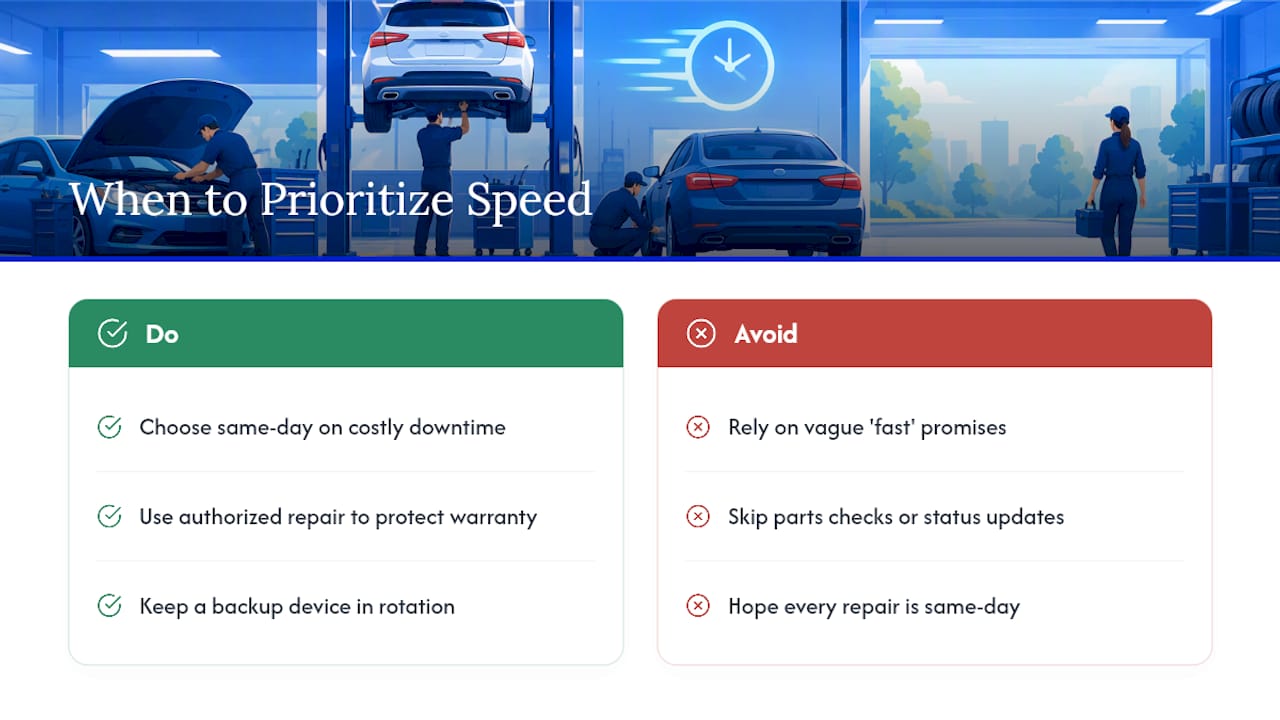
Same-day, on-site repair is the right call whenever downtime itself is the expensive part, a work laptop, a phone tied to two-factor logins, a tablet a small business runs its point-of-sale on. Authorized repair still makes sense when a device is under manufacturer warranty and the extra days protect that coverage.
Businesses that can’t tolerate any downtime should keep a backup device in rotation rather than hoping every repair lands in the same-day band. And treat any turnaround promise that sounds suspiciously fast, with no mention of parts checks or status updates, as a guess dressed up as a guarantee.
— Michael
Get a Fast, Honest ETA From Repair Genius
Repair Genius exists for exactly the scenario this article just walked through: the moment you need a device fixed today, not shipped off for a week. Because technicians come to your home, office, or coffee shop table in Orlando and Winter Park, you skip the drop-off queue and the mail-in wait entirely, and most cracked screens, dead batteries, and stuck charging ports get resolved in a single visit.

Booking is straightforward: describe the device and the issue, confirm the model, and a technician gives you a banded ETA before any work starts, backed by transparent pricing with no surprise fees. Phones and tablets are covered through the cellphone and Android repair page and the dedicated iPhone repair services page, while laptops and desktops needing hardware or software work can start at the on-site computer repair page. Have your model number handy and your device backed up, and most repairs are done before you’d have finished shipping it to a mail-in center.
Sources
- Google Pixel support — repair timeline (mail-in)
- Repair turnaround time: Benchmarks & how to reduce it — BytePhase
- How long does phone repair take? — RepairRange
FAQ
What Is Repair Turnaround Time?
Repair turnaround time is the total elapsed time between dropping off or diagnosing a device and getting it back in working condition. It typically falls into one of three bands: same-day for common fixes like screens and batteries, multi-day for diagnostics-heavy issues like water damage, and parts-wait for board-level repairs needing shipped components.
Why Is My Apple Repair Taking So Long?
Apple and other manufacturer mail-in programs build shipping and centralized queuing into their estimates, which is why Google’s own Pixel mail-in program quotes 7 to 10 business days even though the actual bench work often takes under an hour. Approval delays for additional issues found mid-repair can add further time on top of that estimate.
What Does Turnaround Time Mean in a Repair Context?
It means the full clock time from intake to completion, not just the minutes a technician spends physically working on the device. Diagnosis, parts sourcing, queueing, and post-repair calibration all count toward the total.
What Is the Average Turnaround Time for a Phone Repair?
Common repairs like screen and battery replacements typically finish in 30 to 90 minutes at a shop that already stocks the part, while water damage or board-level work can take 24 hours to multiple days. On-site same-day services aim to complete most common repairs during a single visit rather than requiring a drop-off and wait.
Recommended
- Device Repair Technician Checklist: 2026 Best Practices
- Minimize Device Repair Disruption: A Pro’s Guide
- How to Expedite Your Laptop Repair Process Fast
- Types of Business Laptop Repairs: 2026 Guide